I have just finished the Second half of American Born Chinese and was pleasantly surprised with the ending. In the second half of the book we get to see the combination of all three stories in the book, The Monkey King, Danny's story and Jin's. I was not expecting the three to combine in such a dramatic way. I would have never guessed Wei-Chen to have been the Monkey Kings son, and for Danny to actually be Jin. I just assumed that the three stories were related but not in the same universe. I really liked the reveal of the connection between the three. However, it felt very rushed to me and I would have liked a bit more foreshadowing to the ending. Overall I still liked the reading and the message of the book of staying true to yourself and that there is no point in hiding your identity. I also felt that although we get a sense of closure with Jin's story and his friendship with Wei-Chen there are still a lot of unresolved issues. For example the mission of Wei-Chen and the relationship between Jin and Amelia. Are we just supposed to be okay with Greg's treatment of Jin and the Jin - Suzy relationship. Also, I assumed that Danny's story was all in Jin's imagination and combining the three at the end leads to some confusion. Not to say that this wasn't the right decision to combine the three, but the execution could have been better. What are your thoughts on the ending? Did you like the combination of the stories at the end?
Tuesday, February 28, 2017
ABC Second reading
I have just finished the Second half of American Born Chinese and was pleasantly surprised with the ending. In the second half of the book we get to see the combination of all three stories in the book, The Monkey King, Danny's story and Jin's. I was not expecting the three to combine in such a dramatic way. I would have never guessed Wei-Chen to have been the Monkey Kings son, and for Danny to actually be Jin. I just assumed that the three stories were related but not in the same universe. I really liked the reveal of the connection between the three. However, it felt very rushed to me and I would have liked a bit more foreshadowing to the ending. Overall I still liked the reading and the message of the book of staying true to yourself and that there is no point in hiding your identity. I also felt that although we get a sense of closure with Jin's story and his friendship with Wei-Chen there are still a lot of unresolved issues. For example the mission of Wei-Chen and the relationship between Jin and Amelia. Are we just supposed to be okay with Greg's treatment of Jin and the Jin - Suzy relationship. Also, I assumed that Danny's story was all in Jin's imagination and combining the three at the end leads to some confusion. Not to say that this wasn't the right decision to combine the three, but the execution could have been better. What are your thoughts on the ending? Did you like the combination of the stories at the end?
Thursday, February 23, 2017
American Born Chinese First read
The book American Born Chinese is a graphic novel containing
three different, yet related stories. The three stories all relate to a sense
of identity and what it means to embrace heritage while trying to blend into a
new environment. The first story that the book open with is one of a Monkey
king who is denied entrance to a party because he does not have shoes, yet
monkey do not wear shoes. After being rejected he barricades himself inside “the
inner bowels of his royal chamber”. He
spends this time mediating to emerge with a new name, the great sage of equal
heaven, and some new shoes. The Monkey king then proceeds to convince all other
gods of his power by fighting them all until they say his name. The gods then
go to the Tze-yo-Tzuh to demand that he do something about the monkey king. The
Monkey king questions Tze-yo-Tzuh’s power by going to the edge of the universe
to find five pillars. In an act of deviance he carves his name into one of the
pillars and also urinates on it. However, he returns only to find that the
pillars were in fact Tze-yo-Tzuh’s hand. Tze-yo-Tzuh tells the Monkey king that
he intended him to be a monkey so he should be who he really is. The Monkey
king refuses to accept this and challenges Tze-yo-Tzuh to a fight to which
Tze-yo-Tzuh replies by burring him under a mountain of rocks so he cannot
practice Kung-Fu. This story is then followed by what I consider to be the main
story, the story of Jin. Jin is of Chinese decent and has recently moved from San
Francisco to a rural community with a very small Asian population. Jin is
ashamed of his culture and spends most of his time trying to avoid who he is,
by perming his hair and attempting to avoid all other Asian students. Jin and
the other Asian kids are often subjected to racial slurs by their peers. The
third story is of Danny, a white American who is visited by his Chinese cousin.
This story is presented as a sit com with a laugh track running along the bottom
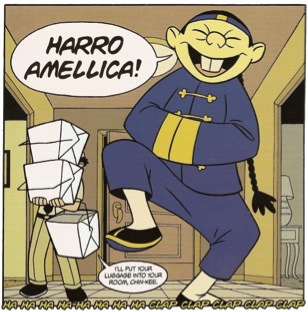
of panels that warrant one. Danny’s Chinese cousin is an embodiment of every Chinese
stereotype rolled into one. Danny struggles to live everyday life with his
cousin and confides in his friend Steve that he has transferred schools three
times since high school because of his cousin. Steve then tells him that he
should embrace his cousin and to shake off any rude comments from others. I see
this last section as almost a Subvertisment within the Novel, exaggerating the extreme
stereotypes Asian Americans may face to bring them to light for a wider audience
to understand.
What are your thoughts on American Born Chinese so far? How do
you thing the Graphic Novel Medium aids in storytelling? How well do you think
the three stories work with each other? Is it too much for one book? Also the term "fresh off the boat" was used a few times in this novel, and funny enough it is actually a the name of an ABC sitcom http://abc.go.com/shows/fresh-off-the-boat
Thursday, February 9, 2017
Applying the Youth lens to Eleanor & Park.
The character of Eleanor is a very accurate description of a troubled teenager, just trying to get by in her home and school environment. She is very realistic about where she stands in her life; about her looks and her home life. This builds a bridge to the youth reader having a lead character with such a firm understanding of where she stands in life, yet not knowing how to escape her surroundings. This realism and very mature understanding of her life suggests that youth readers will be more willing to to relate to and understand her when she does somewhat irrational things. Life ruining away from parks house the first time she visits and her general disdain towards Park at the very beginning of their relationship. Through out the novel we are also bombarded by pop culture references, which, at first may seem a but dated, but non-the less helps to draw the reader in with familiar names and books. This softens the youth reader to the acceptance of the larger themes discussed in the the novel, such as sense of self and social economic problems. Issues that may not draw the youth in upon first glance. There is also a significant amount of growth in the novel, and a general strive to become more adult like form both Eleanor & Park. This can be related to by most youth and can be seen as an attempt to draw them closer to the text. It does so in a way that eases the reader into empathizing with the two by gradually exposing the two to adult concepts, such as driving around town, before making the full plunge of an overnight road trip. How do you think the youth lens applies to Eleanor and park? To Feed?
Tuesday, February 7, 2017
Yaqui Delgado wants to kick your ass has been a great read so far, especially relating to our previous class discussions on bullying and Eleanor & Park. This book also seems to touch on self identity issues also, as most young adult novels do. In this case it seems to be more about what it means to come from a certain culture, as Piddy is ridiculed for not being "Latin enough", since her skin is a lighter complexion and she gets good grades. This lead me to some interesting thought about bullying. Over 67% of students believe that schools respond poorly to bullying, with a high percentage of students believing that adult help is infrequent and ineffective. Over the coarse of a year, over a fourth of students reported bullying based on race. I think its very important for young students to be able to identify the signs of bullying before it gets too serious. Funny enough, Yaqui Delgado wants to kick your ass has been ban in several school districts for its harsh language and violent themes. I strongly disagree with this and personally believe that no book should ever be ban. By censoring certain topics you take away vital information needed to make choices based on critical thinking. So what are your opinions? How are you liking the topic of bulling and its coverage in Yaqui Delgado wants to kick your ass has? Do you think there are legitimate grounds to censor this book?
Subscribe to:
Comments (Atom)